Short answer: A dog who is reactive only on leash usually isn't being two different dogs: on leash, they can't choose their distance, curve away or greet at their own pace, so worry, frustration or excitement boils over. Skip nose-to-nose greetings for now, cross early or turn away to make space, and reward your dog for noticing other dogs at a distance where they can still take food.
Why does the leash change my dog's behavior?
Off leash, in a fenced play area, dogs can arc around each other, sniff, move away or approach slowly. On a sidewalk, the leash removes most of those choices. A dog who wants to greet may get frustrated; a dog who wants space may feel trapped. Both can bark, pull and lunge. For the wider picture, see why dogs bark and lunge on leash.
Does off-leash friendliness mean on-leash greetings are safe?
No. Don't treat calm off-leash play as proof that a close on-leash meeting will go well. For now, skip greetings on narrow paths. A loose leash, where it's safe, gives your dog room to move without constant pressure; it isn't a reason to let them reach another dog.
How do I help a dog who is reactive only on leash, step by step?
- Make space first. Cross the street early, turn down a side street or step behind a parked car when a dog appears.
- Practice a U-turn at home. Teach a cheerful "this way" turn when nothing is around, so leaving is easy when a dog shows up unexpectedly.
- Find a wide area. Pick a spot where another dog can pass at a distance where yours can notice, eat and move normally. See finding your dog's working distance.
- Treats while the dog is in view. Offer food while the other dog is visible, then walk away.
- Watch for "too close." A hard stare, stiffening, refusing food or barking means you need more distance next time.
- Don't ask for a sit under pressure. If another dog is heading straight at yours, moving away is often kinder and safer.
What should I avoid?
Don't test a theory by unclipping the leash in an unsecured place. Don't force greetings to "socialize" your dog. And don't punish barking; it can hide warning signs without changing how your dog feels.
When should I get help?
If lunging risks a bite or you can't hold the leash safely, work with a qualified reward-based behavior professional. A sudden change in behavior can have a medical cause, so check with your vet first.
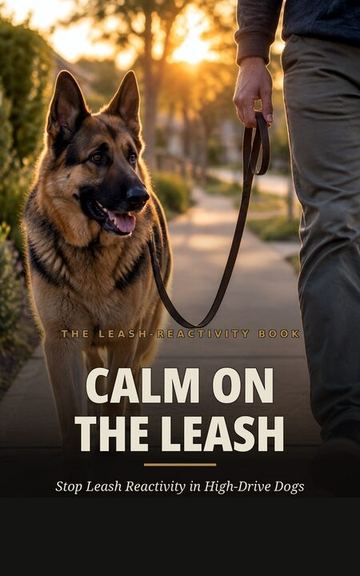
For a deeper look at why the leash changes the picture and how to practice safely, the Calm on the Leash guide covers barking and lunging step by step. The first chapter is free to read.
Does one of these sound like yours?
Choose what fits. Nothing is saved or submitted.
Sources & care notes
Sources: Cornell University College of Veterinary Medicine, managing reactive behavior. Dogs Trust, reactive dogs.
A sudden change in behavior can have a medical cause. If something feels off, check with your vet first.
Frequently asked questions
If my dog is friendly off leash, why bark on leash?
The leash restricts movement and forces or blocks greetings, so the same passing dog becomes much harder to cope with.
Does off-leash friendliness prove close greetings are safe?
No. Skip nose-to-nose meetings on narrow paths for now, cross early or put space between the dogs.
How do we practice?
Find a wide area where another dog can pass at a distance where yours can notice, eat and move normally. Treat while the dog is in view, then walk away.
Should I ask for a sit as a dog approaches?
Usually not. Moving away is often the kinder, safer option.
Is my dog aggressive if they're reactive only on leash?
Not necessarily. Many dogs are frustrated or worried rather than aggressive. Take any bite risk seriously and get individual help.